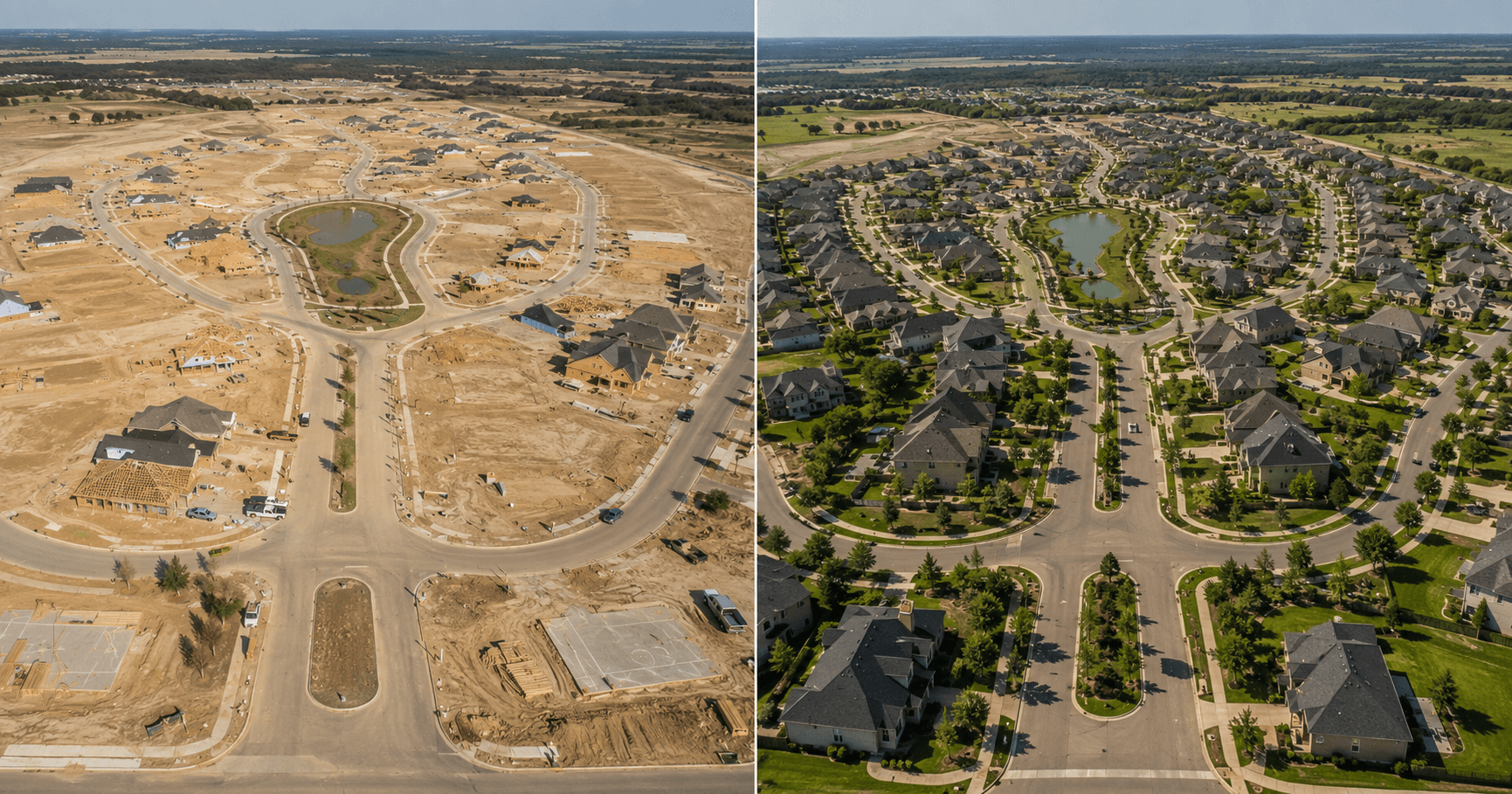

Every new master-planned community starts with the same sales pitch: get in early, lock in the best pricing, pick the best lot, and watch your equity grow as the community fills in around you. Sometimes that pitch is accurate. Sometimes it is not. Here is an honest breakdown of what first-phase buying actually looks like, what the real risks are, and when waiting for a later phase makes more sense.
The Legitimate Case for Buying Early
Lot selection
This is the most defensible reason to buy in phase one. The best lots in any community go first. Corner lots, cul-de-sac lots, lots backing to greenbelts or water, lots on quieter streets with no through traffic - these are claimed early and do not come back. If a specific lot characteristic matters to you, waiting means accepting whatever remains.
Pricing before the market reacts
Builders in early phases are sometimes more motivated to close quickly because they need sales to trigger construction financing for future phases. This can translate into better base pricing, stronger incentives, or more flexibility on lot premiums. It is not guaranteed, but it is more common in early phases than in later ones when the community has proven itself.
Long-term appreciation potential
A community that goes from raw land to a fully built-out master-planned development with open amenities and retail tends to appreciate meaningfully over that cycle. Early buyers capture that appreciation. Late buyers pay for it. This is real but it requires patience and tolerance for a multi-year construction environment.
The Honest Risks of First-Phase Buying
Construction noise and activity for years
This is the most underestimated downside. In a large community like Two Step Farm or Colton, active construction will be happening adjacent to your home for three to five years or more. Heavy equipment, concrete trucks, framing crews, and the general chaos of active development is part of daily life for early residents. Some people adjust fine. Others find it significantly affects their quality of life and regret buying early.
Incomplete amenities
The pool on the community site rendering and the pool that exists when you move in are often years apart. Early buyers pay HOA dues for amenities that do not yet exist. This is not fraudulent - it is disclosed - but buyers routinely underestimate how much it will bother them to see the amenity center in the sales brochure while watching dirt lots out their window.
School zoning uncertainty
School district boundaries get redrawn as new communities fill up. An assignment to a specific elementary campus in phase one does not guarantee the same assignment by the time your child is actually attending. Both Magnolia ISD and Montgomery ISD have redistricted growing areas before, and will again. If a specific campus is critical to your decision, get the district's current attendance zone in writing and understand that it may change.
Retail and dining gaps
Master-planned communities plan for retail. Retail follows rooftops. In the early phases of a large community, the promised H-E-B or the restaurant row is typically still years away. Early residents drive further for everything.
Builder risk concentration
If you buy in phase one and the builder has financial difficulties or exits the market before completing the community, you can be left in a half-built neighborhood with an uncertain future. This is rare with established builders but not impossible. Researching the builder's track record and financial stability matters more in early phases than later ones.
When to Buy Early vs Wait
Buy early if: a specific lot type is critical to you and the inventory will not last, you have tolerance for a multi-year construction environment, you are taking a long view of three to seven years or more, and the builder has a strong track record of completing what they start.
Wait for later phases if: you have children in school now and cannot afford a redistricting disruption, you want amenities that are actually open, you are sensitive to noise and construction activity, or you have a shorter time horizon and need stability from day one.
How to Evaluate Any Specific Community
The most useful question to ask is not "is this a first-phase community" but "how many homes are sold and occupied versus planned total." A community that is 30% built out behaves very differently from one that is 10% built out. Look at the pace of sales, the builder's completion timeline, and the amenity construction schedule specifically.
We track inventory movement week over week across Colton, Kresston, Wildtree, Two Step Farm, and 16 other North Houston communities. That data tells you exactly how fast each community is absorbing homes, which is the best predictor of when it will stabilize. Subscribe to the weekly report to see current absorption rates for every community we track.
Michael Krynski is a Keller Williams The Woodlands and Magnolia agent who has helped buyers navigate both early-phase and established community purchases across North Houston. Book a free call to talk through timing for any specific community you are considering.
Michael Krynski
Keller Williams The Woodlands & Magnolia agent specializing in North Houston new construction. Helps buyers navigate builder contracts, incentives, and community selection across Magnolia, Conroe, The Woodlands, and Montgomery.